
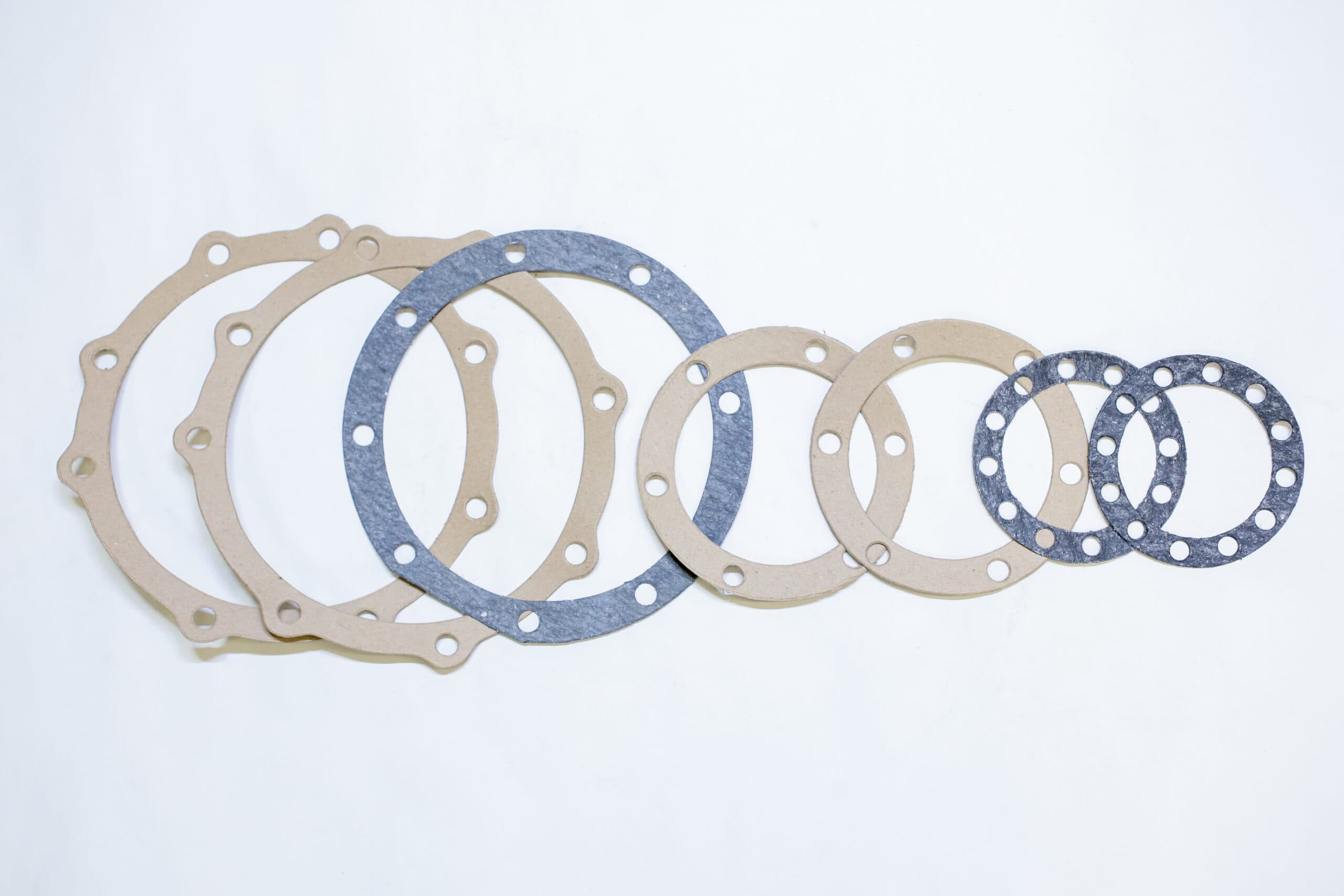
Nitrile gaskets
Nitrile gaskets for oil, fuel and hydraulics.
Nitrile is the rubber that oil, fuel and hydraulic fluid cannot easily swell. We cut nitrile gaskets, washers and seals to your drawing in nitrile rubber and nitrile-bonded cork, for gearboxes, pumps, engines and hydraulic equipment.
- Nitrile rubber we cut
- 1 to 25 mm
- Nitrile-bonded cork we cut
- 0.8 to 25 mm
- Typical service range of nitrile
- -30°C to +100°C
Why nitrile
Why nitrile is the standard oil-resistant gasket rubber.
Nitrile rubber, also called NBR or Buna-N, is a copolymer of acrylonitrile and butadiene. The acrylonitrile makes the rubber polar, and oils and fuels, which are not, find little to dissolve into. The result is a rubber that keeps its size, hardness and grip in mineral oils, greases, petrol, diesel and most hydraulic fluids.
Nitrile is also tough, resists abrasion and compression set well, and costs far less than fluoroelastomers. That combination has made it the default gasket and seal rubber in engines, gearboxes, pumps, compressors and hydraulic plant, from thin washers to thick flange gaskets.
Its weakness is the outdoors. Ozone and sunlight crack standard nitrile, and it does not like high heat, ketones or some brake and fire-resistant fluids. Our guide to rubber gasket materials shows how it compares with the other elastomers.
All rubber gasket materialsGrades
How acrylonitrile content changes nitrile.
Nitrile is not one material. Its acrylonitrile (ACN) content typically runs from about 18% to 50%, and that single figure moves its properties in two directions at once. More acrylonitrile means better resistance to oil and fuel, but a stiffer rubber that loses flexibility at a higher temperature and takes more compression set.
Most general gasket sheet is a medium-ACN grade, a good balance for oil service in a normal climate. If the gasket meets aggressive fuels, or will work in severe cold, tell us, because the grade matters.
Nitrile by acrylonitrile content
Typical trends, not a specification
| ACN content | Typical effect | Typical use |
|---|---|---|
| Low: 18% to 24% | Most flexible in the cold; least oil resistant | Seals working well below freezing |
| Medium: 28% to 34% | Balanced oil resistance and flexibility | General oil, grease and hydraulic gaskets |
| High: 38% to 50% | Best oil and fuel resistance; stiffer in the cold | Fuel systems and aromatic oils |
- Low: 18% to 24%
- Most flexible in the cold; least oil resistant
- Typical use: Seals working well below freezing
- Medium: 28% to 34%
- Balanced oil resistance and flexibility
- Typical use: General oil, grease and hydraulic gaskets
- High: 38% to 50%
- Best oil and fuel resistance; stiffer in the cold
- Typical use: Fuel systems and aromatic oils
General trends; the compound and its cure also matter. The data sheet for the grade we supply applies.
Properties
Nitrile properties for gasket design.
These are typical values for medium-ACN nitrile sheet, for comparing materials at the design stage. The data sheet for the grade we supply applies to your part.
If a joint runs hotter than nitrile allows, hydrogenated nitrile (HNBR) takes the same oils to about 150°C, and a fluoroelastomer goes further still.
Nitrile gaskets cut to your drawingNitrile (NBR): typical properties
General values, not a specification
| Property | Typical value |
|---|---|
| General | |
| Polymer | Acrylonitrile butadiene rubber (NBR, Buna-N) |
| Density | 1.2 to 1.5 g/cm³, by compound |
| Mechanical | |
| Hardness | 50 to 90 Shore A; 60 to 70 Shore A is common |
| Tensile strength | 4 to 15 MPa, by grade |
| Elongation at break | 200% to 500% |
| Abrasion and compression set | Good |
| Thermal | |
| Service temperature | -30°C to +100°C |
| Short-term peak | About +120°C |
| Resistance | |
| Mineral oils, greases and fuels | Very good |
| Mineral hydraulic fluids | Very good |
| Water | Good; special compounds to about +100°C |
| Ozone and sunlight | Poor unless protected |
| Attacked by | Ketones, esters, aromatic and chlorinated solvents, glycol brake fluids, phosphate ester fluids |
General
- Polymer
- Acrylonitrile butadiene rubber (NBR, Buna-N)
- Density
- 1.2 to 1.5 g/cm³, by compound
Mechanical
- Hardness
- 50 to 90 Shore A; 60 to 70 Shore A is common
- Tensile strength
- 4 to 15 MPa, by grade
- Elongation at break
- 200% to 500%
- Abrasion and compression set
- Good
Thermal
- Service temperature
- -30°C to +100°C
- Short-term peak
- About +120°C
Resistance
- Mineral oils, greases and fuels
- Very good
- Mineral hydraulic fluids
- Very good
- Water
- Good; special compounds to about +100°C
- Ozone and sunlight
- Poor unless protected
- Attacked by
- Ketones, esters, aromatic and chlorinated solvents, glycol brake fluids, phosphate ester fluids
Typical published values for medium-ACN nitrile. Ask for the data sheet of the grade we supply.
What we cut
Nitrile gaskets and washers we cut.
We cut solid nitrile rubber for gaskets, washers and seals, and nitrile-bonded cork for covers and housings that need more compressibility; see our guide to cork gaskets. Nitrile washers are cut to your inside and outside diameters, and our page on custom washers and spacers explains how to specify them.
Tell us the size, tolerance and quantity, the oil or fuel, and the temperature, and we will confirm the grade and cutting method. For production runs, die cutting gives fast, consistent parts.
Cut to your drawing
Gaskets, washers, flat seals and complex profiles.
Fluid advice
We check the grade against your oil, fuel or hydraulic fluid.
Nitrile from PSG
Materials and thicknesses
| Material | Available thicknesses |
|---|---|
| Nitrile rubber | 1.000 to 25.000 mm |
| Nitrile-bonded cork | 0.800 to 25.000 mm |
| Nitrile insertion rubber | On request |
| Food-grade nitrile | On request |
| Cutting | Die cut or water jet cut, by thickness |
- Nitrile rubber
- 1.000 to 25.000 mm
- Nitrile-bonded cork
- 0.800 to 25.000 mm
- Nitrile insertion rubber
- On request
- Food-grade nitrile
- On request
- Cutting
- Die cut or water jet cut, by thickness
Other grades, hardnesses and thicknesses on request.
Applications
Where nitrile gaskets are used.
Wherever a gasket sits in oil, fuel or hydraulic fluid, nitrile is usually the first rubber considered.
- Automotive
Automotive
Engines and gearboxes
Sump, cover, pump and transmission gaskets in contact with engine and gear oils.
- Industrial
Hydraulics
Hydraulic equipment
Flat seals and washers for mineral-oil hydraulic pumps, valves and manifolds.
Fuel
Fuel systems
Gaskets for tanks, filters and pumps carrying petrol, diesel and heating oil.
Pumps
Pumps and compressors
Casing, cover and flange gaskets for oil-lubricated machines.
Plant
Agricultural and off-road plant
Oil and grease seals for tractors, loaders and heavy equipment.
Food
Food processing
Seals that meet fats and oils, in food-quality grades.
Limits
Limits of nitrile: weather, ozone and heat.
Ozone in the air attacks the double bonds in nitrile's butadiene, and a stretched or compressed nitrile gasket left outdoors can crack within months. Protected compounds help, but for a seal that lives in sunlight, neoprene or EPDM is safer, and for oil and weather together, ask us about blends or FKM fluoroelastomer.
Heat is the second limit. Above about 100°C in continuous service, standard nitrile hardens and loses its seal. Hydrogenated nitrile extends the range, and fluoroelastomers go higher still.
Finally, check the fluid. Nitrile resists mineral oils, but it is attacked by ketones, esters, aromatic and chlorinated solvents, glycol-based brake fluids and phosphate ester fire-resistant hydraulic fluids. If the fluid is not a mineral oil, tell us what it is. Our guide to neoprene gaskets covers the weather-resistant alternative.
Talk to our technical teamNitrile gasket FAQs
Nitrile gasket questions, answered.
Can't find what you need? Our technical team is happy to help.
Is nitrile the same as NBR and Buna-N?
Yes. Nitrile, NBR (nitrile butadiene rubber) and Buna-N are names for the same family of acrylonitrile butadiene rubbers. Grades within the family differ in acrylonitrile content and compound, so if your drawing calls for a particular grade or standard, tell us and we will match it.
What temperature range can nitrile gaskets take?
Standard nitrile is typically used from about -30°C to +100°C, with short peaks to about +120°C. Low-acrylonitrile grades stay flexible in colder conditions, and hydrogenated nitrile (HNBR) works to about 150°C. The data sheet for the grade we supply gives its rated limits.
Nitrile or neoprene?
Choose nitrile when the gasket sits in oil, fuel or hydraulic fluid: it resists them far better. Choose neoprene when the gasket lives outdoors, needs flame resistance or meets only light oil splash, because nitrile cracks in sunlight and ozone.
Can nitrile gaskets be used outdoors?
Only with care. Standard nitrile is attacked by ozone and sunlight and can crack, especially when stretched or compressed. Ozone-protected compounds last longer, but for a seal permanently outdoors, neoprene or EPDM is usually the better choice unless oil contact rules them out.
Are food-grade nitrile gaskets available?
Food-quality nitrile compounds are made for seals that meet fats and oils in food processing. Ask us about food-grade nitrile for your part, and for the declaration of compliance that applies to the grade, before you order. Tell us the food type and temperature so we can check the grade.
Can you cut nitrile washers?
Yes. We cut nitrile washers to your inside and outside diameters and thickness, from 1 to 25 mm in solid nitrile, as well as gaskets and flat seals. Send us the sizes, the tolerance and the quantity, or a drawing for anything more complex.
Have a nitrile gasket to specify?
Send us the drawing, the oil or fuel, the temperature and the quantity, and our technical team will confirm the grade and quote for the cut parts.
Gasket and shim materials
More materials and methods
Viton™ is a trademark of The Chemours Company. Klingersil® is a trademark of Klinger. Other names are the trademarks of their owners.
- Read more
Gasket and sealing materials
Rubber gaskets
Every common elastomer compared, plus insertion, natural and butyl rubber.
- Read more
Gasket and sealing materials
Neoprene gaskets
Solid neoprene, neoprene foam and neoprene-bonded cork.
- Read more
Gasket and sealing materials
EPDM gaskets
Weather, water and steam resistant rubber seals.
- Read more
Gasket and sealing materials
Viton™ (FKM) gaskets
Fluoroelastomer seals for fuels, chemicals and heat.
- Read more
Gasket and sealing materials
Silicone gaskets
Solid, sponge and food-grade silicone for heat and cold.
- Read more
Gasket and sealing materials
PTFE gaskets
Chemically inert gaskets, washers and shims.
- Read more
Gasket and sealing materials
Cork gaskets
Nitrile and neoprene bonded cork for covers and housings.
- Read more
Gasket and sealing materials
Gasket paper and fibre
Compressed fibre, Klingersil® and fibre jointing.
- Read more
Gasket and sealing materials
Foam gaskets
Closed-cell foams and sponge for sealing and cushioning.
- Read more
Electrical insulation and thermal
Electrical insulation materials
Papers, films and sheet cut into insulators.
- Read more
Plastics and components
Engineering plastics
Nylon, acetal, polycarbonate and PVC parts to drawing.
- Read more
Cutting methods
Die cutting
Flatbed and rotary die cutting, prototype to volume.
Our customers