
Washers and spacers
Custom washers and spacers, in any material.
When a standard washer is the wrong size, material or thickness, we cut one that fits. Plastic, PTFE, fibre, rubber, colour-coded Polymex® and metal washers and spacers, cut to your inside and outside diameters, in the quantity you need.
- Washer thicknesses we cut, by material
- 0.005 to 50 mm
- Colour-coded Polymex® thicknesses
- 12 to 3,000 µm
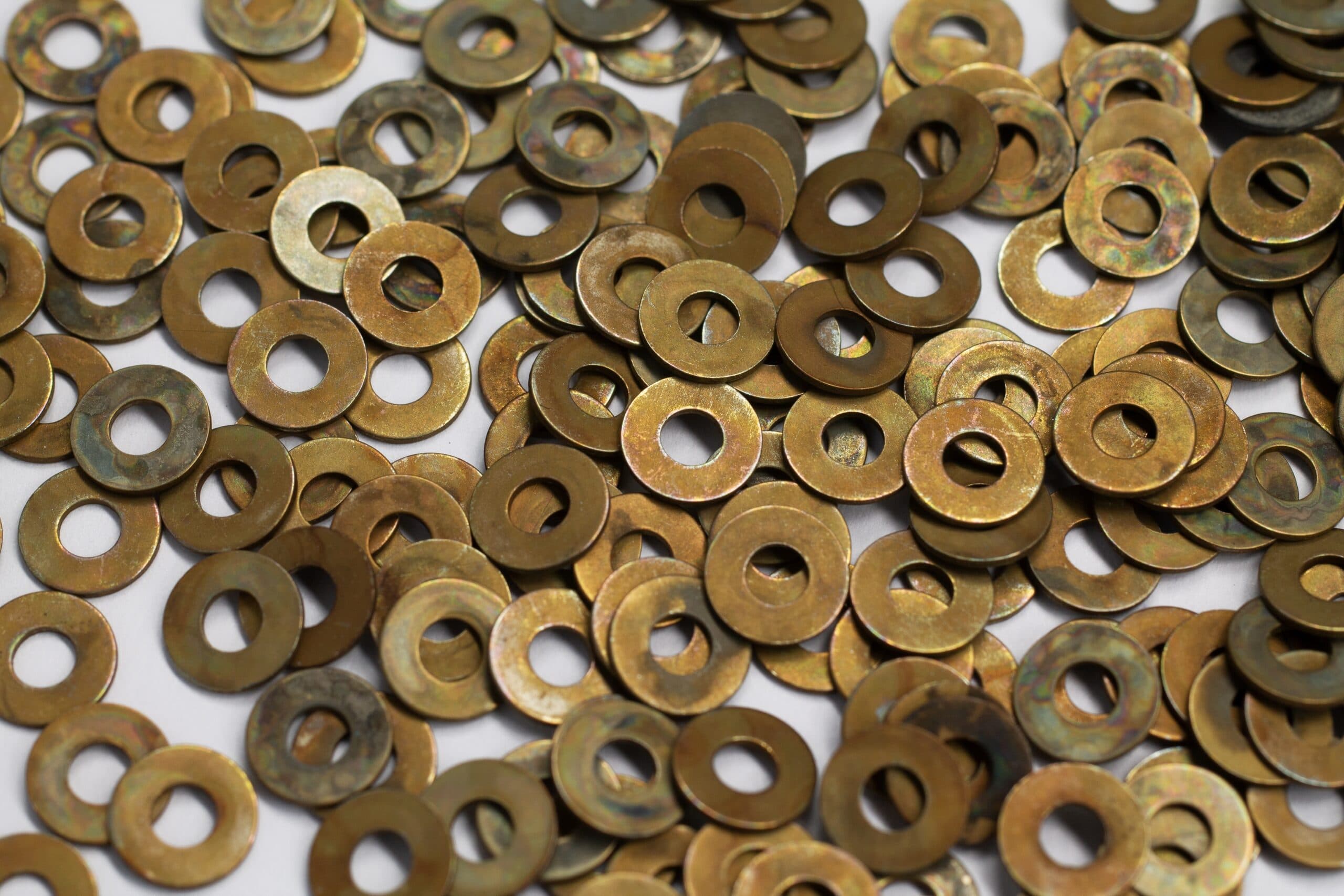
Washers and spacers
Washers, spacers and shim washers: what each one does.
A washer sits under a nut or a bolt head. A flat washer spreads the clamping load and protects the surface. An insulating washer stops current or heat passing through the fastener, a sealing washer stops a fluid leaking past it, and a thrust or anti-friction washer lets two parts turn against each other without wearing.
A spacer holds two parts a set distance apart, and a shim washer is a thin washer that takes up a gap or sets a height, often stacked to the exact thickness needed. The difference is mostly one of purpose: the same ring of material can be any of them, so the material and the thickness are what you are really choosing.
Standard washers come in fixed metric and imperial sizes in a handful of materials. Custom washers are cut to the diameters, thickness and material your design needs, which is how odd sizes, thin gauges, insulating materials and shapes such as tabbed, D-shaped or multi-hole washers are made.
Types of shims explainedMaterials
Washer materials and what they are for.
The material decides what a washer can do. This is general guidance for choosing one, and the data sheet for the grade we supply applies to your part.
Each family has its own guide: engineering plastics for nylon, acetal and polycarbonate, gasket paper and fibre for fibre washers, rubber gasket materials for rubber, and PTFE gaskets and washers for PTFE.
Polymex® is a trademark of PSG. Klingersil® is a trademark of Klinger. Nomex® is a trademark of Arclin or its affiliates. Kapton® is a registered trademark of its owner. Other names are the trademarks of their owners.
Washer materials compared
General guidance, not a specification
| Material | Why choose it | Typical uses |
|---|---|---|
| Plastics | ||
| Nylon | Tough, light, insulating, low friction | Thrust, spacer and insulating washers |
| Acetal | Stiff, low friction, holds its size when damp | Precision spacers, bearing and wear washers |
| PTFE | Chemically inert, lowest friction, typically -200°C to +260°C | Washers in chemical plant, anti-friction washers |
| Polymex® polyester and polypropylene | Colour-coded by thickness, insulating, will not corrode | Shim washers, spacers and packers |
| Polycarbonate and rigid PVC | Rigid and insulating; PVC at low cost | Insulating spacers and barriers |
| Fibre and insulation | ||
| Compressed fibre, such as Klingersil® | Seals under a high clamping load; resists oil and heat | Sealing washers on drains, unions and flanges |
| Vulcanised fibre | Hard, tough, insulating, arc resistant | Electrical insulating and sealing washers |
| Nomex® and Kapton® | High-temperature electrical insulation in thin gauges | Insulating washers in motors and electronics |
| Rubber and metal | ||
| Neoprene, nitrile, EPDM and silicone | Seal and cushion at a low clamping load | Sealing washers, anti-vibration pads |
| Brass, copper, steel, stainless steel and aluminium | Strong, stiff and heat proof; copper also seals | Shim washers, load-spreading and sealing washers |
Plastics
- Nylon
- Tough, light, insulating, low friction
- Typical uses: Thrust, spacer and insulating washers
- Acetal
- Stiff, low friction, holds its size when damp
- Typical uses: Precision spacers, bearing and wear washers
- PTFE
- Chemically inert, lowest friction, typically -200°C to +260°C
- Typical uses: Washers in chemical plant, anti-friction washers
- Polymex® polyester and polypropylene
- Colour-coded by thickness, insulating, will not corrode
- Typical uses: Shim washers, spacers and packers
- Polycarbonate and rigid PVC
- Rigid and insulating; PVC at low cost
- Typical uses: Insulating spacers and barriers
Fibre and insulation
- Compressed fibre, such as Klingersil®
- Seals under a high clamping load; resists oil and heat
- Typical uses: Sealing washers on drains, unions and flanges
- Vulcanised fibre
- Hard, tough, insulating, arc resistant
- Typical uses: Electrical insulating and sealing washers
- Nomex® and Kapton®
- High-temperature electrical insulation in thin gauges
- Typical uses: Insulating washers in motors and electronics
Rubber and metal
- Neoprene, nitrile, EPDM and silicone
- Seal and cushion at a low clamping load
- Typical uses: Sealing washers, anti-vibration pads
- Brass, copper, steel, stainless steel and aluminium
- Strong, stiff and heat proof; copper also seals
- Typical uses: Shim washers, load-spreading and sealing washers
General guidance. Grades differ, so ask us to check your choice against the load, temperature and medium.
What we cut
Washer and spacer materials we cut.
These are the washer materials we cut most often and the thicknesses they come in. A washer can be cut from almost any sheet we supply, so if yours is not listed, ask our sales team.
For colour-coded Polymex® washers and gaskets, see custom plastic gaskets; for thin metal washers and rings, see our metal shims. We also cut bespoke ratchet and anti-friction discs.
Any size
Every washer is cut to your diameters and thickness, from plain rings to multi-hole profiles.
Washer materials from PSG
Materials and thicknesses
| Material | Available thicknesses |
|---|---|
| Polymex® polyester and polypropylene | 0.012 to 3.000 mm |
| Nylon | 0.500 to 2.000 mm |
| PTFE | 0.500 to 50.000 mm |
| Rigid PVC | 0.250 to 6.000 mm |
| Klingersil® compressed fibre | 0.250 to 3.000 mm |
| Nomex® | 0.050 to 0.760 mm |
| Kapton® | 0.023 to 0.125 mm |
| Neoprene and nitrile rubber | 1.000 to 25.000 mm |
| Food grade silicone rubber | 1.000 to 10.000 mm |
| Brass, copper, aluminium, phosphor bronze, nickel, stainless steel and steel | 0.005 to 3.000 mm |
| Acetal and vulcanised fibre | On request |
- Polymex® polyester and polypropylene
- 0.012 to 3.000 mm
- Nylon
- 0.500 to 2.000 mm
- PTFE
- 0.500 to 50.000 mm
- Rigid PVC
- 0.250 to 6.000 mm
- Klingersil® compressed fibre
- 0.250 to 3.000 mm
- Nomex®
- 0.050 to 0.760 mm
- Kapton®
- 0.023 to 0.125 mm
- Neoprene and nitrile rubber
- 1.000 to 25.000 mm
- Food grade silicone rubber
- 1.000 to 10.000 mm
- Brass, copper, aluminium, phosphor bronze, nickel, stainless steel and steel
- 0.005 to 3.000 mm
- Acetal and vulcanised fibre
- On request
Other materials and thicknesses on request.
Specifying
Specifying a custom washer.
Six details make a washer quotable. A dimensioned sketch is enough for a plain ring; for anything more complex, send a drawing.
- 01
Inside and outside diameter
The bore (ID) and the outside diameter (OD), and which matters more. For a bolt, the bore is usually a clearance size a little larger than the bolt.
- 02
Thickness
The nominal thickness, and whether it is critical. In thin gauges, the sheet's own thickness tolerance usually sets the washer's.
- 03
Tolerance
The tolerance on each diameter, or whether a general tolerance will do. Tight tolerances can change the cutting method and the cost.
- 04
Flatness and edges
Whether the washer must lie flat, with clean, square edges, as a shim washer under a precision fit must.
- 05
Material and duty
The material if you know it; if not, the temperature, what the washer touches and whether it must insulate, seal or slide.
- 06
Quantity
The quantity now and the expected yearly volume, so that we can choose between cutting without a tool and die cutting.
Polymex®
Colour-coded Polymex® shim washers.
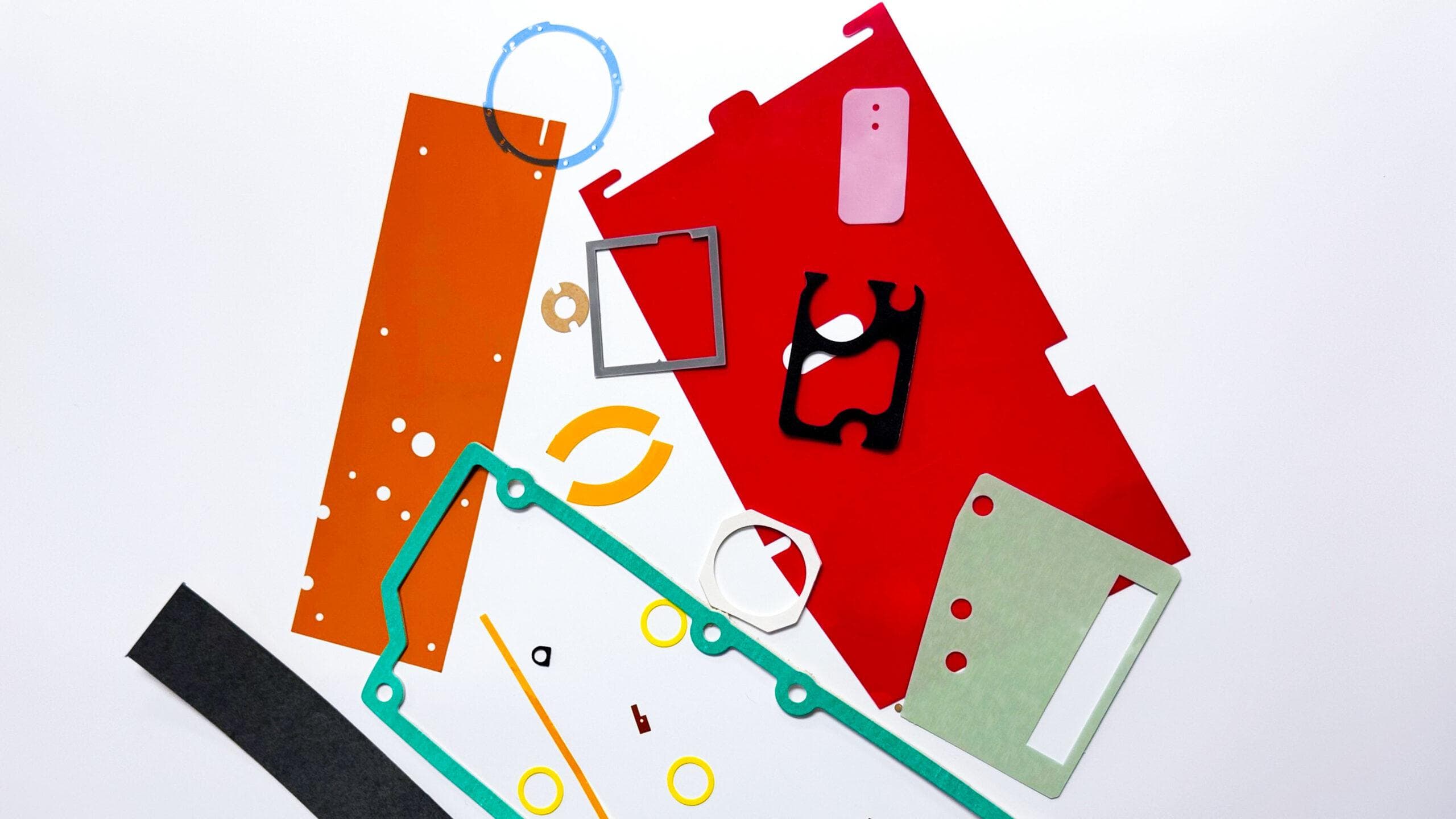
Shim washers cut from Polymex® carry their thickness in their colour. Every thickness from 12 to 3,000 microns has its own colour, so a fitter picks the right washer by sight instead of measuring it, and an inspector can check a stack at a glance.
Polymex® A is polyester, from 0.012 to 0.350 mm, and Polymex® B is polypropylene, from 0.375 to 3.000 mm. Both insulate electrically, will not corrode and resist oils and moisture, which makes them a practical replacement for metal shim washers in many assemblies. Polymex® is made at Polymex House in Hinckley, Leicestershire.
To make up a gap from several washers, the shim stack calculator finds the fewest colour-coded thicknesses that add up to it.
Pick the right shim washer by its colour, not with a micrometer.Polymex® shimstock
Insulating and sealing
Insulating, sealing and anti-friction washers.
The commonest reasons for a custom washer are to stop current passing through a fastener, to stop a fluid leaking past it and to let parts move without wearing.
Insulating washers
Two flat insulating washers, one under the bolt head and one under the nut, with an insulating sleeve through the hole, isolate a fastener completely. Nomex®, Kapton®, polyester, nylon and PTFE are the usual materials, chosen by temperature and voltage.
Thermal isolation
Insulating washers and spacers also break heat paths, for example between a hot component and its mounting. PTFE, Nomex® and fibre suit the higher temperatures.
Sealing washers
Rubber, fibre and PTFE washers seal drain plugs, unions and fittings. Rubber seals at a low clamping load; compressed fibre and copper take a high load and heat.
Corrosion barriers
A plastic washer between dissimilar metals, such as aluminium and stainless steel, stops galvanic corrosion at the joint.
Thrust and anti-friction washers
PTFE, nylon and acetal washers let parts rotate against each other without lubrication, in a filled grade where they turn continuously.
Cutting
From prototype to production: laser or die cut washers.
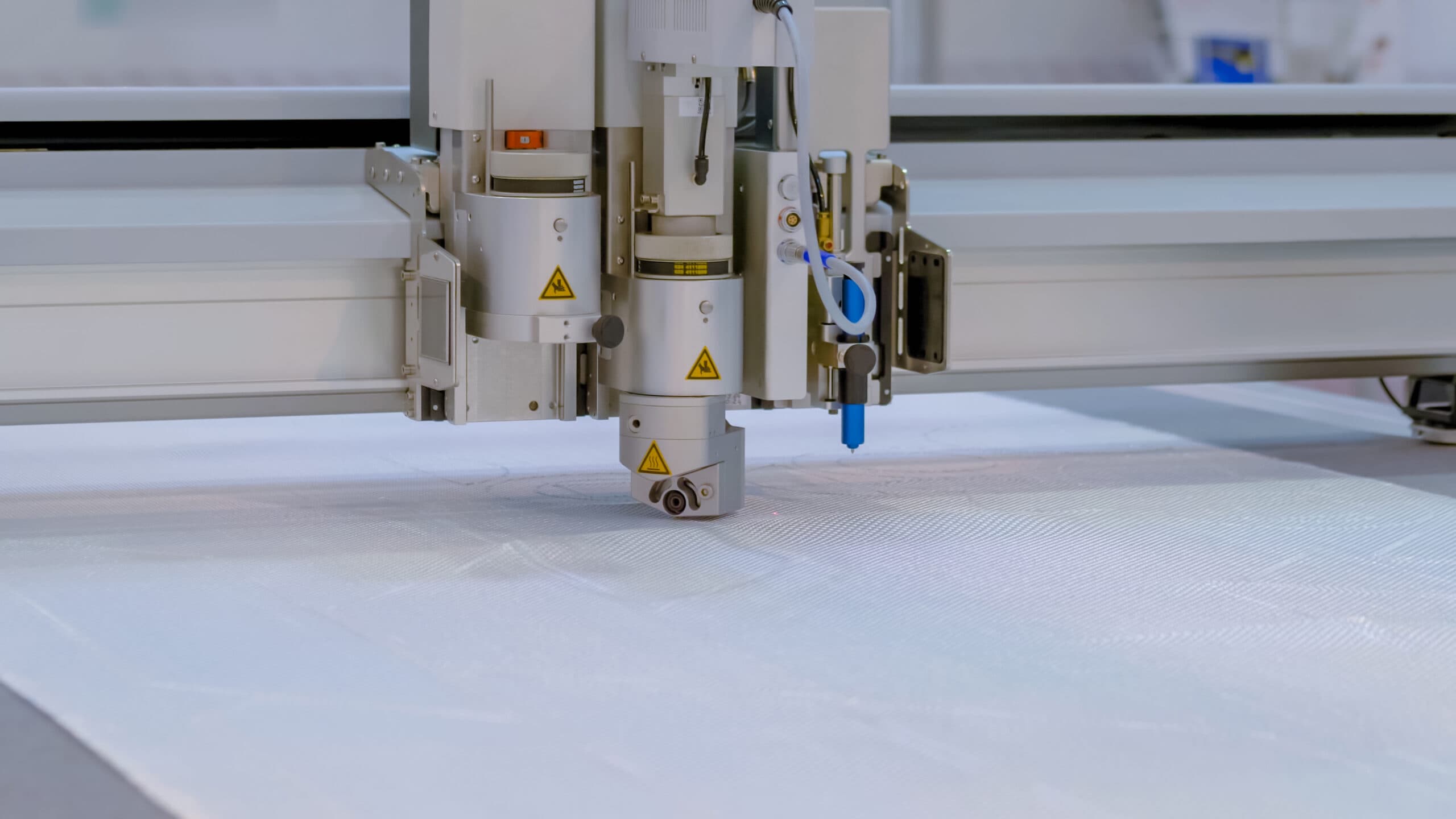
For a few washers, or while a design is still changing, cutting without a tool is the quickest route. The shape is cut straight from the drawing, so there is no tool to pay for, and a change costs nothing but a new file. Laser cutting suits thin films and many plastics; water jet cutting suits thick rubber, PTFE and plastic plate.
For production quantities, die cutting is faster and cheaper per part. A cutting tool punches the bore and the outside diameter in one stroke, so every washer is concentric and identical, run after run. The same drawing can move from laser to die cutting when the volume justifies a tool, and our guide to die cutting explains how it works.
Tell us your quantities when you ask for a quote, and we will recommend the method.
Laser and water jet cuttingWasher FAQs
Washer questions, answered.
Can't find what you need? Our technical team is happy to help.
Which material makes the best insulating washer?
For most electrical work, nylon, polyester or PTFE washers are enough. Where it runs hot, use Nomex®, rated up to about 220°C by insulation system, or Kapton®, which takes about 400°C for short periods and is used continuously in insulation systems rated 200°C and above. Where the washer also carries a heavy clamping load, a hard material such as vulcanised fibre or a filled PTFE creeps less. Tell us the voltage and the temperature and we will suggest a material.
Nylon or PTFE washers?
Nylon is stronger, stiffer and cheaper, and suits most spacer, thrust and insulating washers up to about 100°C. PTFE costs more but resists almost every chemical, works from about -200°C to +260°C and has lower friction. Choose PTFE for chemical duty, high temperatures or dry sliding, and nylon for general mechanical use. Nylon absorbs some water; PTFE absorbs almost none.
What is a shim washer?
A shim washer is a thin, flat washer used to take up a gap, set a height or adjust end float on a shaft, rather than to spread a load. Several can be stacked to reach an exact thickness. We cut them in metal and in colour-coded Polymex®, where each thickness has its own colour.
Can you make non-standard washer sizes?
Yes. Every washer we make is cut to your sizes: any inside and outside diameter, any thickness we supply and any shape, from plain rings to tabbed, D-shaped or multi-hole washers. Send a dimensioned sketch or a drawing with the material and the quantity.
Is there a minimum order?
We quote for the quantity you need, from prototypes to production runs. Small quantities are usually cut without a tool, so there is no tooling cost to spread across them. Tell us the quantity when you ask for a quote and we will confirm the price and any minimum that applies.
How do I specify a washer?
Give the inside diameter, the outside diameter, the thickness and the tolerance on each, the material, or the temperature and what it touches, and the quantity. A dimensioned sketch is enough for a plain washer; a drawing helps for anything more complex. Then request a quote and our team will come back to you.
Send us your sizes.
Send the diameters, thickness, material and quantity, or a drawing, and our technical team will quote for your washers and spacers.
Gasket and shim materials
More materials and methods
- Read more
Plastics and components
Engineering plastics
Nylon, acetal, polycarbonate and PVC parts to drawing.
- Read more
Gasket and sealing materials
Rubber gaskets
Every common elastomer compared, plus insertion, natural and butyl rubber.
- Read more
Electrical insulation and thermal
Electrical insulation materials
Papers, films and sheet cut into insulators.
- Read more
Cutting methods
Die cutting
Flatbed and rotary die cutting, prototype to volume.
- Read more
Reference
Types of shims
Shim materials, shapes and stacks, and how to specify one.
- Read more
Overview
Gasket and shim materials
Every material we cut, compared in one place.
Our customers