
Engineering plastics
Engineering plastic parts, cut to your drawing.
Nylon, acetal, polycarbonate, rigid PVC, HIPS, polyethylene and polypropylene replace metal wherever a part has to be lighter, quieter, insulating or corrosion proof. We cut washers, spacers, wear pads, insulators and bearing plates from engineering plastic sheet to your drawing, and help you choose the plastic.
- Engineering plastic thicknesses we cut, by material
- 0.25 to 15 mm
- Typical upper limit, rigid PVC to polycarbonate
- +60°C to +120°C

Why plastics
Engineering plastics in place of metal.
An engineering plastic is a thermoplastic with enough strength, stiffness and dimensional stability to do a mechanical job, not just to enclose or protect something. Acetal, nylon and polycarbonate are the classic examples. Rigid PVC, high impact polystyrene (HIPS), polyethylene and polypropylene cost less and are often good enough for flat parts such as spacers, packers and insulators.
Swapping a metal part for a plastic one removes a whole set of problems. Plastic does not rust or cause galvanic corrosion between dissimilar metals, it insulates electrically, it runs against steel with little or no lubrication, it deadens noise and vibration, and it weighs a fraction as much. A flat part cut from sheet also needs no machining, so it is usually cheaper to make in quantity.
The trade-offs are heat, stiffness and creep. Most of these plastics soften well below 150°C, they are far less stiff than steel, and under a steady load they slowly deform. Nylon also absorbs water and grows slightly. The table below shows where each one stops working; for the highest temperatures and chemical duty, PTFE is the plastic to look at.
Plastic washers and spacersCompared
Engineering plastics compared: temperature, strength and moisture.
These are typical values for unfilled sheet, for comparing plastics at the design stage. Grades, fillers and the way a sheet is made all shift the figures, and the data sheet for the material we supply applies to your part.
Read the service temperature as the limit for a lightly loaded part. Where the part carries a steady load or must hold a close dimension, stay well below it.
Engineering plastics: typical properties
General values, not a specification
| Plastic | Typical value (Service temperature / Tensile strength) | Water absorption, 24 hours |
|---|---|---|
| Engineering plastics | ||
| Acetal (POM copolymer) | Service temperature-40°C to +100°CTensile strength60 to 70 MPa | About 0.2% |
| Nylon 6.6 (PA66) | Service temperature-40°C to +100°CTensile strength75 to 85 MPa (dry) | About 1%; up to 8% when saturated |
| Polycarbonate (PC) | Service temperature-40°C to +120°CTensile strength55 to 70 MPa | About 0.15% |
| Commodity plastics | ||
| Rigid PVC | Service temperature0°C to +60°CTensile strength45 to 55 MPa | Below 0.1% |
| High impact polystyrene (HIPS) | Service temperature-20°C to +70°CTensile strength20 to 35 MPa | Below 0.1% |
| High density polyethylene (HDPE) | Service temperature-50°C to +80°CTensile strength20 to 30 MPa | Below 0.01% |
| Low density polyethylene (LDPE) | Service temperature-50°C to +65°CTensile strength8 to 15 MPa | Below 0.01% |
| Polypropylene (PP) | Service temperature-10°C to +100°C, by gradeTensile strength30 to 35 MPa | Below 0.03% |
| For comparison | ||
| Virgin PTFE | Service temperature-200°C to +260°CTensile strength20 to 35 MPa | Below 0.01% |
Engineering plastics
- Acetal (POM copolymer)
- Service temperature-40°C to +100°CTensile strength60 to 70 MPa
- Water absorption, 24 hours: About 0.2%
- Nylon 6.6 (PA66)
- Service temperature-40°C to +100°CTensile strength75 to 85 MPa (dry)
- Water absorption, 24 hours: About 1%; up to 8% when saturated
- Polycarbonate (PC)
- Service temperature-40°C to +120°CTensile strength55 to 70 MPa
- Water absorption, 24 hours: About 0.15%
Commodity plastics
- Rigid PVC
- Service temperature0°C to +60°CTensile strength45 to 55 MPa
- Water absorption, 24 hours: Below 0.1%
- High impact polystyrene (HIPS)
- Service temperature-20°C to +70°CTensile strength20 to 35 MPa
- Water absorption, 24 hours: Below 0.1%
- High density polyethylene (HDPE)
- Service temperature-50°C to +80°CTensile strength20 to 30 MPa
- Water absorption, 24 hours: Below 0.01%
- Low density polyethylene (LDPE)
- Service temperature-50°C to +65°CTensile strength8 to 15 MPa
- Water absorption, 24 hours: Below 0.01%
- Polypropylene (PP)
- Service temperature-10°C to +100°C, by gradeTensile strength30 to 35 MPa
- Water absorption, 24 hours: Below 0.03%
For comparison
- Virgin PTFE
- Service temperature-200°C to +260°CTensile strength20 to 35 MPa
- Water absorption, 24 hours: Below 0.01%
Typical published values for unfilled grades at 23°C. Ask for the data sheet of the grade we supply.
Selection
Which engineering plastic suits the part?
Choose what the part needs and the table narrows the field. Treat it as a first filter: grades within each plastic differ, so ask us to check your choice against the load, the temperature and the environment.
What does the part need?
Choose properties to find the right material. 8 materials compared.
| Requirement | Acetal | Nylon | Polycarbonate | Rigid PVC | HIPS | Polyethylene | Polypropylene | PTFE |
|---|---|---|---|---|---|---|---|---|
| Low friction and wearPTFE has the lowest friction; lubricated nylons and UHMW polyethylene wear best. | Yes | Yes | No | No | No | Yes | No | Yes |
| Stiff and strong under load | Yes | Yes | Yes | No | No | No | No | No |
| High impact strength | No | Yes | Yes | No | Yes | Yes | No | No |
| Holds its size in water or humidityNylon absorbs water and grows slightly. | Yes | No | Yes | Yes | Yes | Yes | Yes | Yes |
| Electrical insulationNylon insulates less well as it takes up moisture. | Yes | No | Yes | Yes | Yes | Yes | Yes | Yes |
| Acids and alkalisStrong acids attack acetal and nylon. | No | No | No | Yes | No | Yes | Yes | Yes |
| Continuous heat above 100°C | No | No | Yes | No | No | No | No | Yes |
| Flame-retardant gradesCheck the UL 94 rating of the exact grade. | No | Yes | Yes | Yes | No | No | Yes | Yes |
| Food-contact grades availableCheck the declaration for the exact grade. | Yes | Yes | Yes | No | Yes | Yes | Yes | Yes |
| TransparentRigid PVC in clear grades only. | No | No | Yes | Yes | No | No | No | No |
General guidance for unfilled grades. We confirm the grades available for your part with the quotation.
What we cut
Engineering plastic parts we cut.
These are the engineering plastics we cut most often and the thicknesses they are available in. Tell us what the part does, the load and temperature it sees and what it touches, and we will confirm the plastic and the cutting method.
Our colour-coded Polymex® B polypropylene is a plastic too: from 0.375 to 3.000 mm, each thickness has its own colour, which makes it a quick choice for spacers and packers, and we cut it into colour-coded plastic shims to your drawing. If you need a plastic that is not listed, ask our sales team.
Polymex® is a trademark of PSG. Lexan™ is a trademark of SABIC. Nylatron® is a trademark of Mitsubishi Chemical Group. Other names are the trademarks of their owners.
Cut to your drawing
Washers, spacers, wear pads, insulators, bearing plates and complex profiles.
Prototypes and production
Prototype components and production runs from the same drawing.
Engineering plastics from PSG
Materials and thicknesses
| Plastic | Available thicknesses |
|---|---|
| Nylon | 0.500 to 2.000 mm |
| Lexan™ polycarbonate | 2.000 to 15.000 mm |
| Rigid PVC | 0.250 to 6.000 mm |
| HIPS | 0.400 to 4.000 mm |
| PTFE | 0.500 to 50.000 mm |
| Polymex® B polypropylene, colour-coded | 0.375 to 3.000 mm |
| Acetal, Nylatron®, polyethylene and polypropylene sheet | On request |
- Nylon
- 0.500 to 2.000 mm
- Lexan™ polycarbonate
- 2.000 to 15.000 mm
- Rigid PVC
- 0.250 to 6.000 mm
- HIPS
- 0.400 to 4.000 mm
- PTFE
- 0.500 to 50.000 mm
- Polymex® B polypropylene, colour-coded
- 0.375 to 3.000 mm
- Acetal, Nylatron®, polyethylene and polypropylene sheet
- On request
Other plastics and thicknesses on request.
The plastics
Acetal, nylon, polycarbonate, PVC and polyolefins in practice.
Each plastic has a job it does best. These are the ones we are asked about most, and what to watch for with each.
Acetal
Stiff, hard and dimensionally stable, with low friction and almost no moisture uptake. The first choice for precision spacers, wear pads, bearing plates and parts that must hold their size. It is fairly brittle in thick section, which limits how thick it can be die cut.
Nylon and Nylatron®
Nylon is tougher than acetal and copes with shock loads, abrasion and vibration, so it is the classic material for thrust washers, spacers and wear strips. It absorbs water and swells slightly, so allow for that in close fits. Nylatron® grades add molybdenum disulphide for lower friction and longer wear in sliding parts.
Polycarbonate
Clear, almost unbreakable and the most heat resistant of this group, to about 120°C. Used for guards, windows, visors and insulators; flame-retardant grades insulate power supplies and switchgear, as our guide to electrical insulation materials explains. Many solvents attack it, and it scratches easily.
Rigid PVC and HIPS
Low-cost sheet that cuts easily, for spacers, covers, insulating barriers, templates and prototypes. Rigid PVC resists water, acids and alkalis and is self-extinguishing, but softens at about 60°C and turns brittle in the cold. HIPS is lighter and cheaper again, for parts that see little heat or chemical exposure.
Polyethylene and polypropylene
The most chemically resistant plastics after PTFE, with almost no water uptake and food-contact grades available. Polyethylene slides well and stays tough in the cold. Polypropylene is stiffer, takes more heat and can be creased into a hinge that flexes thousands of times.
Where they are used
Pumps, valves, conveyors, machine guards, lighting and electrical equipment are typical homes for cut plastic parts. Our industrial sector page shows more of the work.
Cutting
Plastic thickness and the cutting method.
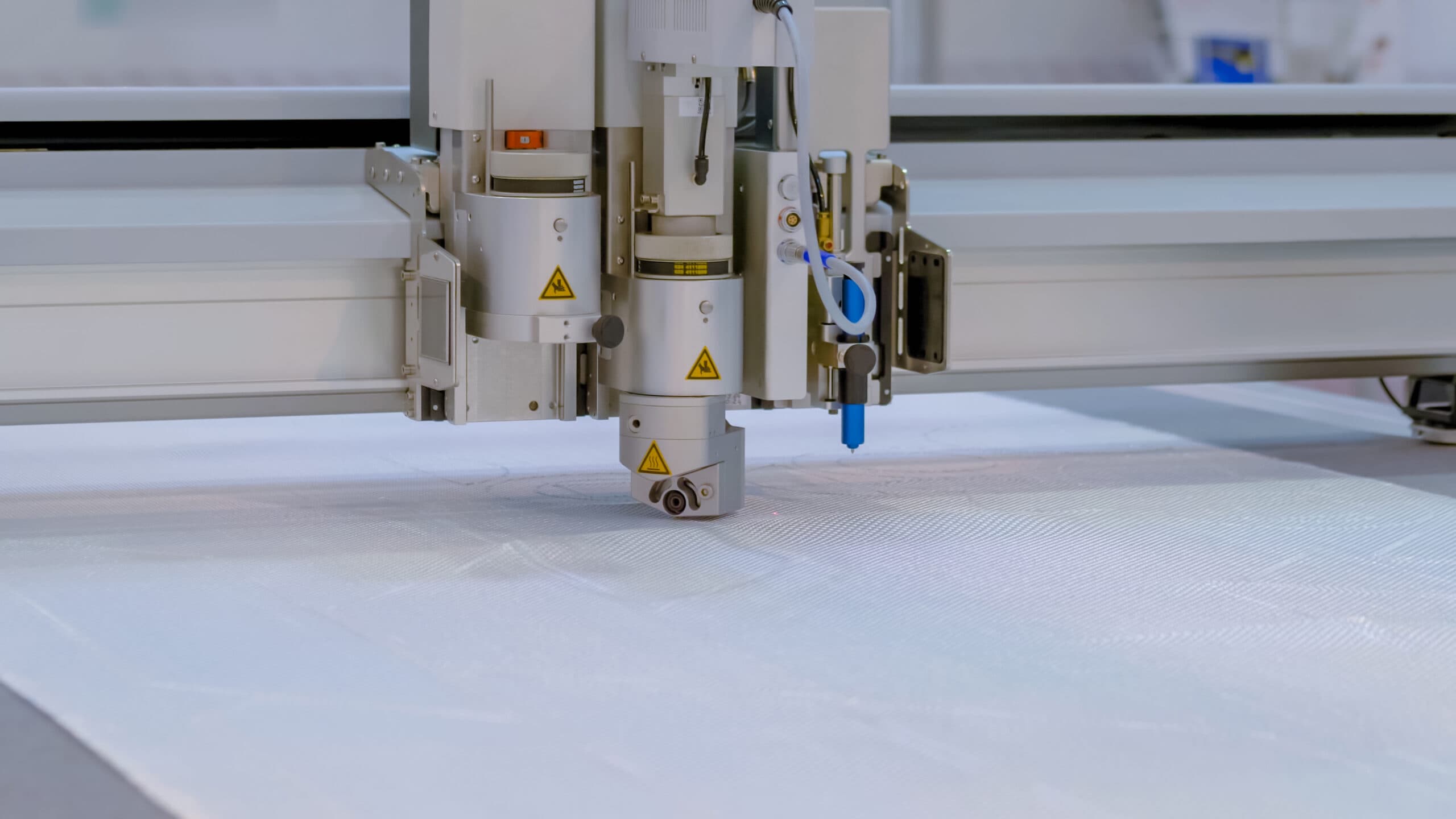
The thickness and stiffness of the plastic decide how it is cut. Thin, tough sheet such as nylon, polypropylene, polyethylene, PVC and polycarbonate film die cuts cleanly and quickly, the economical route for production quantities. As sheet gets thicker and harder, a die starts to crush or crack the edge instead of shearing it: we advise die cutting acetal only up to about 1.5 mm.
Thicker plate is cut without a tool. Water jet cutting leaves a clean, square edge with no heat, which suits thick polycarbonate, nylon and acetal. Laser cutting is fast and precise on many plastics but not all: it discolours the edge of polycarbonate, and it must never be used on PVC, which gives off corrosive hydrogen chloride when burnt. Our guide to laser and water jet cutting explains the difference, and we choose the method that gives a reliable part at the right cost.
The thicker and harder the plastic, the more likely it is to be cut without a tool.Talk to our technical team
Engineering plastics FAQs
Engineering plastics questions, answered.
Can't find what you need? Our technical team is happy to help.
Acetal or nylon: which should I choose?
Choose acetal where the part must hold its size, run against metal with low friction or sit somewhere damp, because it absorbs almost no water. Choose nylon where toughness matters more: shock loads, impact and abrasion. Nylon absorbs water and grows slightly, so it suits looser fits. For sliding parts, a lubricated nylon such as Nylatron® closes the gap on friction.
Can polycarbonate be die cut?
Yes, in thin gauges. Polycarbonate film and thin sheet are tough rather than brittle, so they die cut cleanly without cracking, and flame-retardant polycarbonate film is often die cut into electrical insulators. Thick polycarbonate plate is cut without a tool, usually by water jet, because a die cannot shear it cleanly.
What thickness of plastic can be die cut?
It depends on the plastic. Soft, tough plastics such as polyethylene, polypropylene and nylon die cut cleanly in thicker gauges than hard, stiff ones: we advise die cutting acetal only up to about 1.5 mm. Above the practical limit, parts are water jet or laser cut instead. Tell us the material and thickness and we will confirm the method.
Which plastic has the lowest friction?
PTFE has the lowest friction of any solid, typically 0.05 to 0.10 against steel. It is soft, though, and wears quickly under load unless it is filled. Where wear life matters as much as friction, acetal, UHMW polyethylene and lubricated nylons give a better balance, which is why they are used for wear pads and thrust washers.
Which engineering plastics are food safe?
Food-contact grades are made in acetal, nylon, polycarbonate, polyethylene, polypropylene and PTFE, among others. Food safety belongs to the grade, not to the plastic family, so the part must be cut from a grade with a declaration of compliance for your use. Ask us for the declaration that applies to the grade we supply.
Can a plastic part replace a metal one?
Often, where the load and temperature allow. Plastic washers, spacers, wear pads and insulators are lighter than metal, do not corrode, insulate electrically and often need no lubrication. Check three things first: the highest temperature, the steady load the part carries, because plastics creep, and whether it must hold a close dimension. Our technical team can check the design with you.
Send us your drawing.
Tell us what the part does, the plastic if you know it, the thickness, the tolerance and the quantity, and our technical team will confirm the material and quote for the cut parts.
Gasket and shim materials
More materials and methods
- Read more
Plastics and components
Washers and spacers
Custom washers and spacers in any material.
- Read more
Gasket and sealing materials
Rubber gaskets
Every common elastomer compared, plus insertion, natural and butyl rubber.
- Read more
Electrical insulation and thermal
Electrical insulation materials
Papers, films and sheet cut into insulators.
- Read more
Cutting methods
Die cutting
Flatbed and rotary die cutting, prototype to volume.
- Read more
Reference
Types of shims
Shim materials, shapes and stacks, and how to specify one.
- Read more
Overview
Gasket and shim materials
Every material we cut, compared in one place.
Our customers