
Die cutting
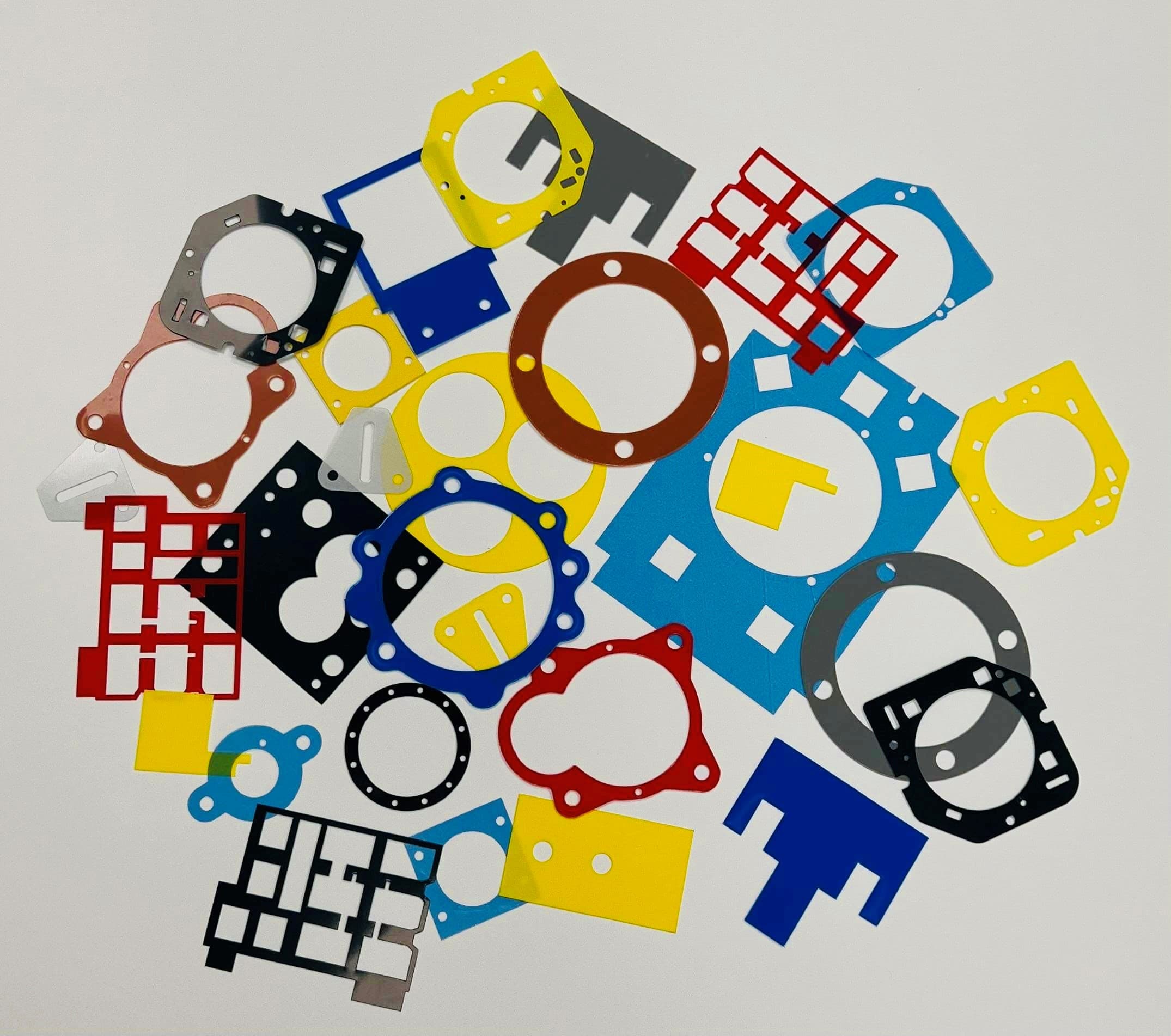
Die cutting for gaskets, shims and components.
Die cutting drives a shaped steel blade through sheet or roll material, cutting the outline and every hole of a part in one stroke. It is the fastest, most repeatable way to make gaskets, shims, washers and insulators in quantity. We die cut most non-metallic materials to your drawing, and tell you when another method would serve you better.
- Gasket materials we cut, all methods
- 0.25 to 50 mm
- Shim materials we cut, all methods
- 0.012 to 150 mm
How it works
What die cutting is, and when it pays.
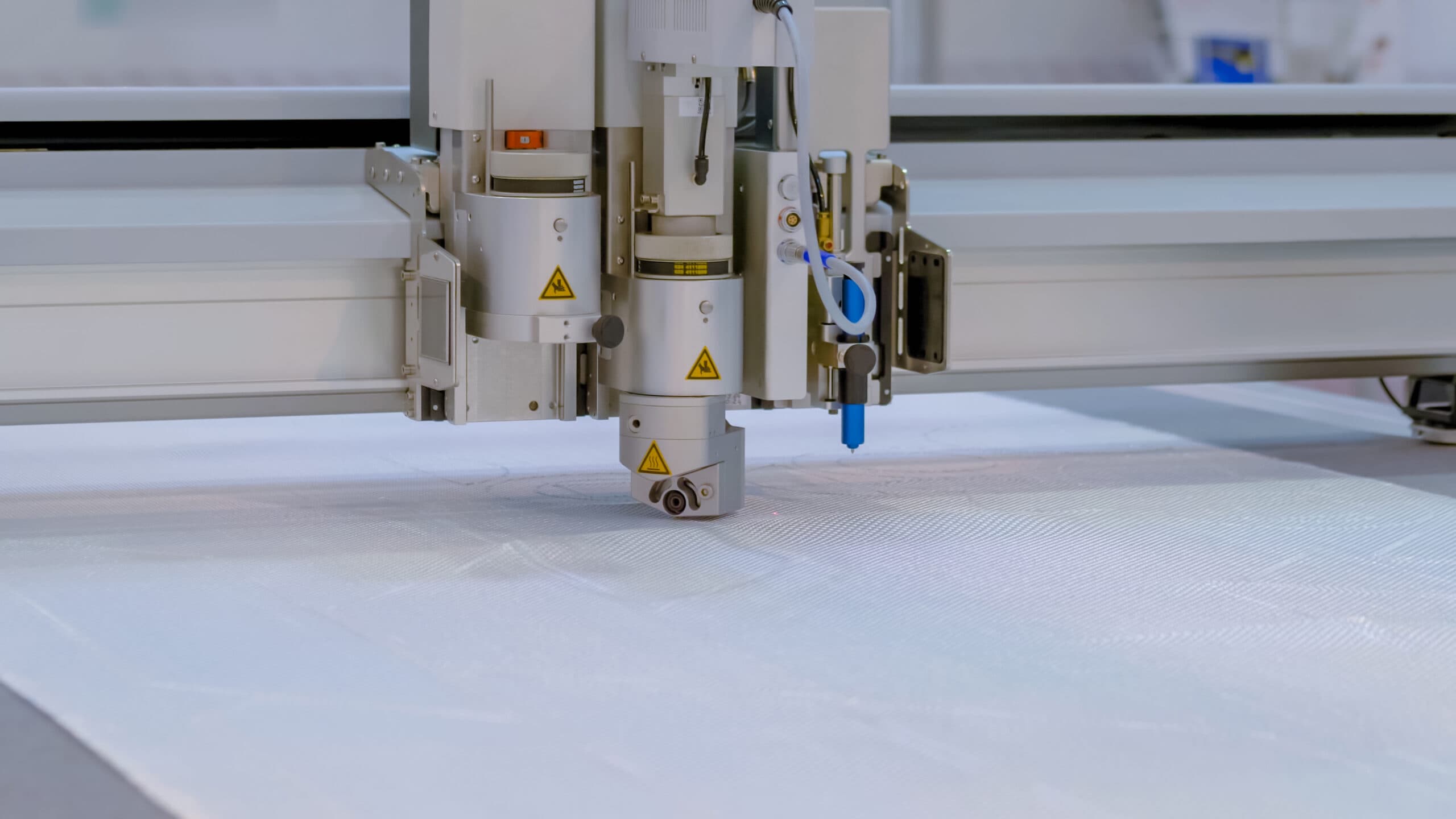
A cutting die is a blade formed to the outline of your part and set in a rigid base. In the press the die is driven through the material against a flat cutting plate, so the outer edge, the bolt holes and any slots are cut in a single stroke and always sit in the same place relative to each other. Ejection rubber packed around the blade pushes the part and the waste free as the press opens.
Because the shape is held in the tool, every part matches the first, and output is fast. That makes die cutting the usual choice for production runs in rubber, cork, fibre, foam, PTFE, films and papers. The trade-off is the tool: it must be made before the first part, at a cost in time and money that a tool-less method avoids. For prototypes and short runs, laser and water jet cutting often make more sense, and the same drawing can move to a die once the design is settled.
Die cutting has limits worth knowing at the design stage. The blade compresses soft material as it enters, so thick rubber and foam can come out with a slightly concave edge. Brittle plastics such as acetal can crack above about 1.5 mm. Very small holes and sharp inside corners need a punch or a radius. Our gasket material chart helps you settle the material before the cutting method.
Every material we cut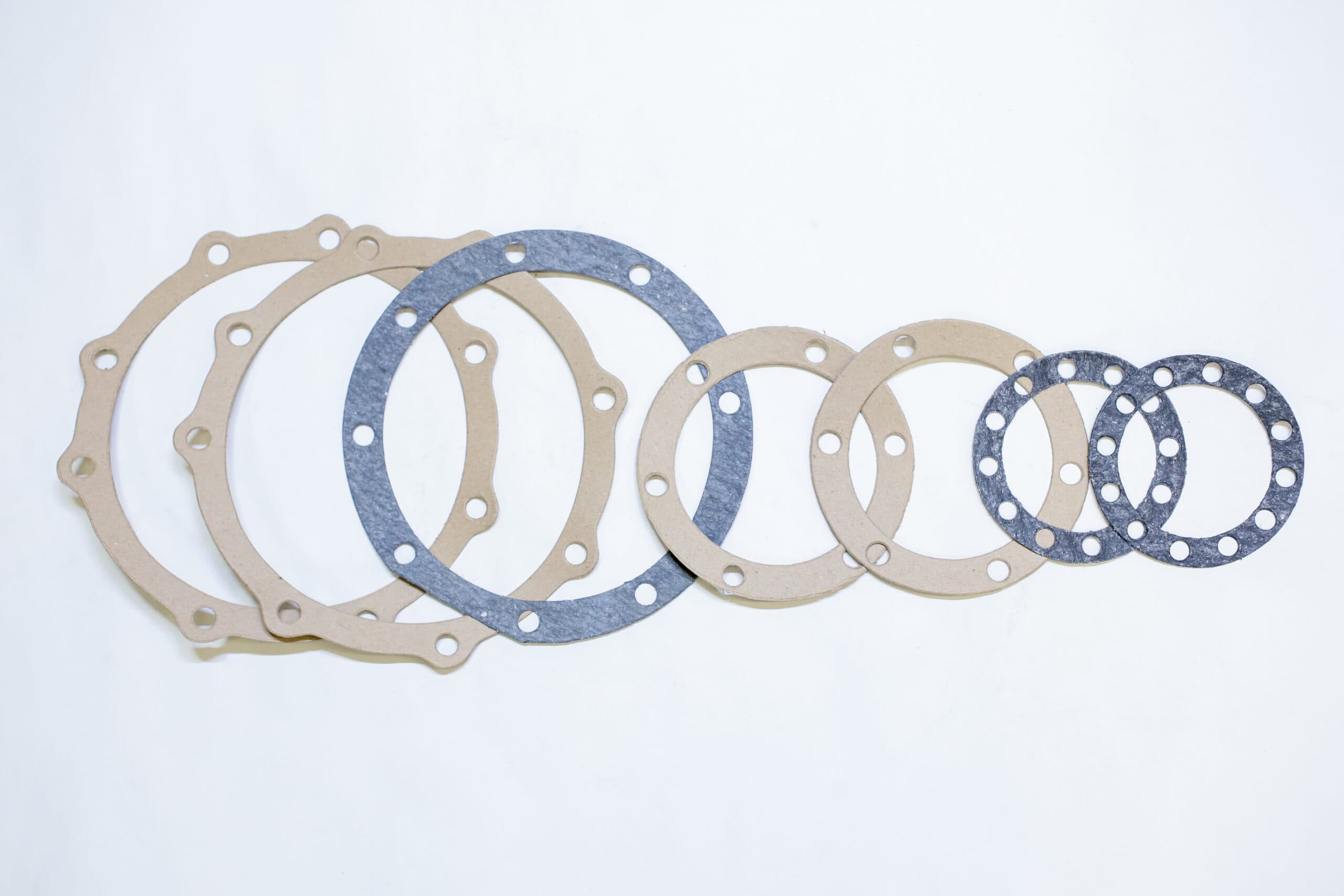
Flatbed die cutting
Flatbed die cutting: clicker, beam and CNC presses.
On a flatbed press the material lies flat and the die comes down on it, one sheet or one length of roll at a time. The press is chosen to suit the tool size, the cutting force and the run length.
Clicker presses
A swinging head over a small bed. The operator places the die on the material and the head strikes it, which suits small parts, thick rubber and short runs, with the die moved around the sheet to save material.
Beam presses
A full-width beam presses large dies, or dies with many cavities, across a whole sheet, with the force to cut large gaskets and thick, dense materials.
Travelling head presses
A cutting head that moves across a wide bed, so a smaller die works across large sheets or roll material.
CNC and automatic feed presses
Programmed presses index sheet or roll material under the die automatically, for consistent spacing, less waste and steady output on longer runs.
The right press for your part
We choose the press and tool layout from the part size, material and quantity, and explain why with the quotation.
Rotary die cutting
Rotary die cutting for high volumes.
A rotary die cutter replaces the flat die with a cylinder. Material runs from the roll between the die cylinder and a hardened anvil roll, and parts are cut continuously as the web moves, at speeds a flatbed press cannot match. Several lanes of parts can run across the web at once, and the same line can laminate an adhesive, cut and strip the waste in one pass.
Rotary tools are either solid cylinders with the cutting edges machined in, which last for millions of parts, or thin flexible plates wrapped on a magnetic cylinder, which cost less and suit shorter runs. Both typically hold tighter tolerances than flatbed tools, and they cut thin films, foils, adhesives, papers and foams best.
The limits are part size, set by the web width and the cylinder's circumference, and thickness: rotary cutting suits materials up to a few millimetres. It pays when volumes run into tens of thousands, as they do for automotive and electronics assemblies. Rotary lines also kiss cut self-adhesive parts, leaving them in place on a liner.
Talk to our technical teamTools and tolerances
Die cutting tools and the tolerances they hold.
The tool sets the tolerance more than the press does. These are typical tolerances for each type of cutting tool on thin, stable material. Soft, thick or stretchy materials move as the blade enters, so tolerances widen with thickness.
Put tight tolerances only on the dimensions that matter, such as bolt hole positions: tight tolerances everywhere add cost without adding function.
Ask about a toleranceCutting tools compared
Typical tolerances, not a specification
| Tool type | Typical tolerance | Best for |
|---|---|---|
| Flatbed tools | ||
| Steel rule die | ±0.25 mm | Most gaskets and flat parts; lowest tool cost, quick to make |
| Banded die | ±0.4 mm | Simple shapes and large gaskets in soft material |
| Forged (clicker) die | ±0.25 mm | Thick rubber, cork and foam; long tool life |
| Matched punch and die | Down to ±0.025 mm | Small, precise parts in thin film and shim; very long runs |
| Rotary tools | ||
| Solid rotary die | ±0.1 mm | High volumes in film, foil, adhesive and foam |
| Flexible plate die | ±0.1 to ±0.15 mm | Medium runs from the roll; lower tool cost than solid |
Flatbed tools
- Steel rule die
- ±0.25 mm
- Best for: Most gaskets and flat parts; lowest tool cost, quick to make
- Banded die
- ±0.4 mm
- Best for: Simple shapes and large gaskets in soft material
- Forged (clicker) die
- ±0.25 mm
- Best for: Thick rubber, cork and foam; long tool life
- Matched punch and die
- Down to ±0.025 mm
- Best for: Small, precise parts in thin film and shim; very long runs
Rotary tools
- Solid rotary die
- ±0.1 mm
- Best for: High volumes in film, foil, adhesive and foam
- Flexible plate die
- ±0.1 to ±0.15 mm
- Best for: Medium runs from the roll; lower tool cost than solid
Typical values on thin, stable material; thicker and softer materials need wider tolerances. We confirm the tolerance for your part with the quotation.
Capabilities
Die cutting capabilities for gaskets, shims and insulators.
These are the limits we work to, as a guide; send us your drawing for a firm answer.
We die cut rubber, foam, cork, fibre, PTFE, electrical insulation papers and films, engineering plastics and colour-coded shimstock. Slitting, sheeting and guillotining are a separate service, handled by our trade conversion services team, and polyester film has its own page on film slitting and sheeting.
Custom shims cut to your drawingDie cutting at PSG
Materials, sizes and formats
| Capability | Range |
|---|---|
| Materials | |
| Materials | Most non-metallic sheet and roll materials |
| Film and sheet thickness | 12 to 3,000 microns (0.012 to 3 mm) |
| Gasket materials, all methods | 0.25 to 50 mm, by material |
| Size and tolerance | |
| Maximum sheet size | Up to 1,600 mm square |
| General tolerance, flatbed | ±0.35 mm on standard parts |
| Rotary die-cut parts | To ±0.1 mm, by material and shape |
| Formats | |
| Supplied as | Loose parts, parts on sheets, or kiss-cut parts on a liner |
Materials
- Materials
- Most non-metallic sheet and roll materials
- Film and sheet thickness
- 12 to 3,000 microns (0.012 to 3 mm)
- Gasket materials, all methods
- 0.25 to 50 mm, by material
Size and tolerance
- Maximum sheet size
- Up to 1,600 mm square
- General tolerance, flatbed
- ±0.35 mm on standard parts
- Rotary die-cut parts
- To ±0.1 mm, by material and shape
Formats
- Supplied as
- Loose parts, parts on sheets, or kiss-cut parts on a liner
A guide only: limits vary with material, thickness and shape. Thick parts are usually water jet cut.
How a job runs
From drawing to delivery: a die cutting job, step by step.
- 01
Drawing or sample
Send a DXF, DWG, PDF, STEP or IGES file with the material, thickness, tolerances and quantity, or a sample to copy. Our custom gaskets page shows the materials most often specified.
- 02
Material and method
We confirm the material grade and whether a die, a laser or a water jet suits your part and your quantity.
- 03
Cutting tool
Where a die is needed, it is quoted separately from the parts, so you can weigh it against a tool-less method.
- 04
First-off approval
For new parts we can supply first-off samples to check against your drawing before the full run.
- 05
Production and inspection
Parts are cut, inspected, and packed and labelled to your requirements.
- 06
Repeat orders
A die can be used again for repeat orders, so the next batch needs no new tooling; tool terms are confirmed with the quotation.
Choosing a method
Die cutting, laser or water jet? Choosing a cutting method.
Each method has a job it does best. Choose what your part needs to see which methods qualify; CNC knife cutting, a computer-guided blade, is included for comparison.
What does the part need?
Choose properties to find the right material. 5 materials compared.
| Requirement | Flatbed die | Rotary die | Laser | Water jet | CNC knife |
|---|---|---|---|---|---|
| Lowest unit cost on long runs | Yes | Yes | No | No | No |
| No cutting tool to make first | No | No | Yes | Yes | Yes |
| Design changes at no tool cost | No | No | Yes | Yes | Yes |
| Fine detail and very small featuresSolid rotary dies and matched punch and die sets hold fine detail at volume. | No | Yes | Yes | No | No |
| Thick rubber and foam, over about 10 mmDie-cut edges on thick soft material can be slightly concave. | Yes | No | No | Yes | Yes |
| Thick PTFE and rigid plastic plate | No | No | No | Yes | No |
| No heat at the cut edge | Yes | Yes | No | Yes | Yes |
| PVC and other chlorinated materialsA laser releases corrosive, toxic gas from chlorinated materials. | Yes | Yes | No | Yes | Yes |
| Dry cut for cork, fibre and paper | Yes | Yes | Yes | No | Yes |
| Self-adhesive parts left on a linerKiss cutting: the cut stops at the liner. | Yes | Yes | Yes | No | Yes |
General guidance; tolerance and quantity also decide the method. We recommend one for your part with the quotation.
Die cutting FAQs
Die cutting questions, answered.
Can't find what you need? Our technical team is happy to help.
What is die cutting?
Die cutting cuts flat parts from sheet or roll material with a blade shaped like the part, which a press drives through the material to cut the outline and holes in one stroke. Fast and repeatable, it is the usual method for gaskets, shims, washers and insulators in production quantities.
What tolerances can die cutting hold?
Typically ±0.25 mm with a steel rule die on thin, stable material, about ±0.1 mm with rotary tools and tighter still with a matched punch and die. Soft, thick materials need wider tolerances because they move as the blade enters. Tell us which dimensions are critical and we will confirm what we can hold.
Who pays for and owns the cutting tool?
A new die is normally quoted as a one-off charge, separate from the price of the parts, and is used only for your parts. The tool cost, its lead time, who owns it and how long it is kept for repeat orders are set out with the quotation. If your volume does not justify a tool, we can quote a tool-less method instead.
Flatbed or rotary die cutting?
Flatbed suits most gaskets, larger parts and thicker materials, with lower tool costs. Rotary suits very high volumes of small, thin parts from the roll, especially self-adhesive ones, and holds tighter tolerances. We recommend one when we see the drawing and the annual quantity.
What materials can be die cut?
Most non-metallic sheet and roll materials: rubbers, foams, cork, gasket fibre, PTFE, papers, polyester and polyimide films, and thin plastics. Brittle plastics such as acetal and rigid PVC die cut cleanly only in thin gauges. Our guide to gasket and shim materials compares them all.
What thickness can you die cut?
Films and sheet from 12 microns (0.012 mm) to about 3 mm, and soft materials such as foam thicker; across all our cutting methods, gasket materials run from 0.25 to 50 mm. Parts too thick for a die, or thick soft parts that need a square edge, are usually water jet cut.
Can you make prototypes without a tool?
Yes. Laser cutting needs no tool, so prototypes and short runs are cut straight from your drawing, and thick parts can be water jet cut. When volumes grow, the same drawing moves to a die for a lower unit cost.
Send us your drawing
Get a quote for die-cut gaskets, shims and components.
- 01
Send your drawing
Upload a DXF, DWG, PDF or STEP file, or describe the part. Everything you send is handled in confidence.
- 02
Material advice
Our technical team helps you select the right material and thickness for the application.
- 03
Precision cut in-house
Die cutting, precision laser or water jet, chosen to hold your specified tolerances.
- 04
Delivered to your deadline
Manufactured in the UK and shipped worldwide.
Request a quote
Tell us what you need and a member of our technical team will be in touch.
Gasket and shim materials
More materials and methods
- Read more
Cutting methods
Kiss cutting
Self-adhesive parts on a liner, ready to peel and place.
- Read more
Cutting methods
Laser and water jet cutting
Cutting without a tool, for prototypes and thick parts.
- Read more
Gasket and sealing materials
Rubber gaskets
Every common elastomer compared, plus insertion, natural and butyl rubber.
- Read more
Electrical insulation and thermal
Electrical insulation materials
Papers, films and sheet cut into insulators.
- Read more
Plastics and components
Engineering plastics
Nylon, acetal, polycarbonate and PVC parts to drawing.
- Read more
Reference
Types of shims
Shim materials, shapes and stacks, and how to specify one.
- Read more
Overview
Gasket and shim materials
Every material we cut, compared in one place.
Our customers