

Polyester film grades
Polyester film grades and finishes.
Every polyester film starts as the same polymer. The grade, meaning the finish, surface treatment, coating and thickness, decides how it prints, seals, insulates and performs. This guide explains the options so you can specify with confidence.
Finishes and treatments
Polyester film types at a glance.
Most grades combine a finish (how the film looks) with a surface treatment or coating (how it behaves). If you already use a grade, give us its name or data sheet and we will supply it or recommend an equivalent. Every grade can be slit, sheeted or die cut to size.
Polyester film types
What each grade is for
| Grade | What it is | Typical uses |
|---|---|---|
| Finish | ||
| Clear and crystal clear | Low-haze film with high light transmission | Windows, overlays, displays, laminates |
| Hazy (general purpose) | Clear film with a slight haze from surface slip additives | Industrial, release liners, tapes, insulation |
| Matt and translucent | Diffusing surface on one or both sides | Drafting, backlit graphics, anti-glare overlays |
| Opaque white and milky white | Pigmented film with strong contrast for print | Labels, cards, tags, printed graphics |
| Black | Pigmented opaque film | Light blocking, insulation, decorative |
| Metallised | Film with a vacuum-deposited aluminium layer | Barrier packaging, decorative, reflective |
| Surface treatment | ||
| Corona treated | Raised surface energy on one or both sides | Printing, laminating, adhesives |
| Chemically treated | Primer coat receptive to solvent or water-based inks, coatings and adhesives | Industrial coating, labels, graphics |
| Slip treated | Lower friction for handling and stacking | Sheet feeding, stationery, display |
| Antistatic | Coating that dissipates static charge | Electronics, clean handling, forensic lifting film |
| Speciality | ||
| Heat sealable | Co-extruded sealing layer on one side | Lidding, top sealing, flow wrap |
| Peelable | Sealing layer designed to peel cleanly | Ready-meal and dual-ovenable tray lidding |
| Anti-fog | Coating that stops condensation forming droplets | Fresh and chilled food packaging |
| Heat stabilised | Pre-shrunk for low shrinkage at temperature | Membrane switches, circuits, printed electronics |
| UV resistant | Stabilised against ultraviolet light | Outdoor, window and solar films, labels |
| Flame retardant | Formulated for flame resistance | Electrical insulation, flexible circuits |
| PVDC coated | High-barrier coating against oxygen and moisture | Barrier packaging |
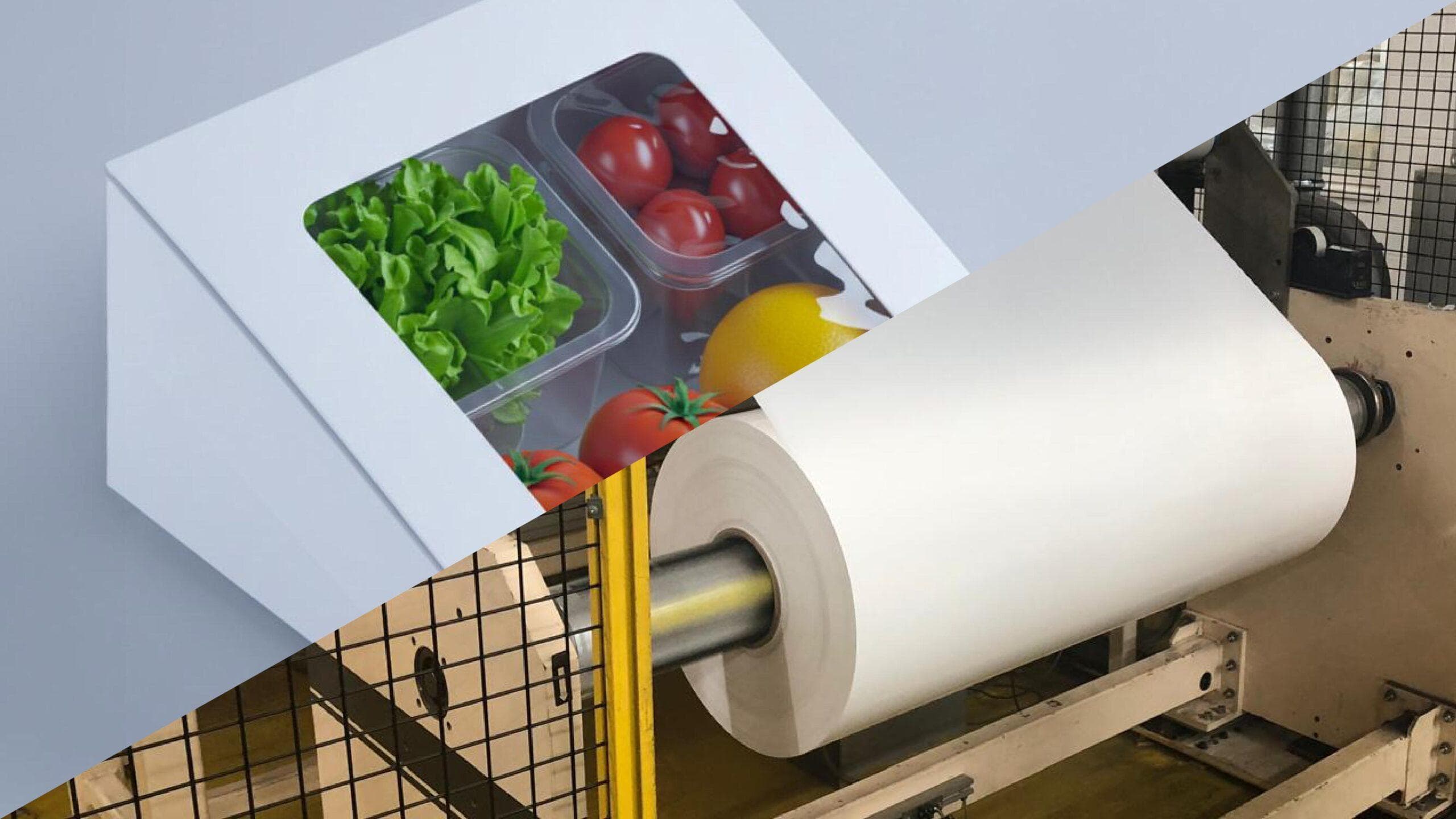
| Recycled content (RPET and PCR) | Post-consumer recycled (PCR) PET: 30% PCR, with 60% and 90% options | Carton windows and packaging |
Finish
- Clear and crystal clear
- Low-haze film with high light transmission
- Typical uses: Windows, overlays, displays, laminates
- Hazy (general purpose)
- Clear film with a slight haze from surface slip additives
- Typical uses: Industrial, release liners, tapes, insulation
- Matt and translucent
- Diffusing surface on one or both sides
- Typical uses: Drafting, backlit graphics, anti-glare overlays
- Opaque white and milky white
- Pigmented film with strong contrast for print
- Typical uses: Labels, cards, tags, printed graphics
- Black
- Pigmented opaque film
- Typical uses: Light blocking, insulation, decorative
- Metallised
- Film with a vacuum-deposited aluminium layer
- Typical uses: Barrier packaging, decorative, reflective
Surface treatment
- Corona treated
- Raised surface energy on one or both sides
- Typical uses: Printing, laminating, adhesives
- Chemically treated
- Primer coat receptive to solvent or water-based inks, coatings and adhesives
- Typical uses: Industrial coating, labels, graphics
- Slip treated
- Lower friction for handling and stacking
- Typical uses: Sheet feeding, stationery, display
- Antistatic
- Coating that dissipates static charge
- Typical uses: Electronics, clean handling, forensic lifting film
Speciality
- Heat sealable
- Co-extruded sealing layer on one side
- Typical uses: Lidding, top sealing, flow wrap
- Peelable
- Sealing layer designed to peel cleanly
- Typical uses: Ready-meal and dual-ovenable tray lidding
- Anti-fog
- Coating that stops condensation forming droplets
- Typical uses: Fresh and chilled food packaging
- Heat stabilised
- Pre-shrunk for low shrinkage at temperature
- Typical uses: Membrane switches, circuits, printed electronics
- UV resistant
- Stabilised against ultraviolet light
- Typical uses: Outdoor, window and solar films, labels
- Flame retardant
- Formulated for flame resistance
- Typical uses: Electrical insulation, flexible circuits
- PVDC coated
- High-barrier coating against oxygen and moisture
- Typical uses: Barrier packaging
- Recycled content (RPET and PCR)
- Post-consumer recycled (PCR) PET: 30% PCR, with 60% and 90% options
- Typical uses: Carton windows and packaging
Grades from different manufacturers combine these features in different ways. Ask for the data sheet for your grade.
Thickness
Typical thickness ranges by film type.
Polyester film is specified in microns (thousandths of a millimetre). In the UK and Europe you will also see gauge (100 gauge is 25.4 microns) and in North America mil (one mil is 25.4 microns), so a 92 gauge film is about 23 microns and a 5 mil film is 127 microns.
Thicker film is stiffer and stronger, and thinner film is more flexible and lower in cost per square metre. Electrical insulation and archival encapsulation usually set a minimum thickness, while packaging film is usually chosen as the thinnest film that still runs well on the packing line.
To convert between microns, gauge and mil, or to work out weight and yield, use our film calculator.
Thickness in microns and millimetres
We quote every grade in microns and millimetres, and convert from gauge or mil for you.
Typical thickness ranges
Across the major film manufacturers
| Film type | Typical range |
|---|---|
| Capacitor and ribbon grades | 3.5 to 16 microns |
| Hazy, general purpose | 9 to 350 microns |
| Clear and crystal clear | 12 to 250 microns |
| Heat sealable | 12 to 40 microns |
| Metallised | 12 to 36 microns |
| Matt and translucent | 12 to 150 microns |
| Opaque and milky white | 23 to 350 microns |
| Antistatic | 71 to 175 microns |
| Polymex® polyester | 12 to 350 microns |
- Capacitor and ribbon grades
- 3.5 to 16 microns
- Hazy, general purpose
- 9 to 350 microns
- Clear and crystal clear
- 12 to 250 microns
- Heat sealable
- 12 to 40 microns
- Metallised
- 12 to 36 microns
- Matt and translucent
- 12 to 150 microns
- Opaque and milky white
- 23 to 350 microns
- Antistatic
- 71 to 175 microns
- Polymex® polyester
- 12 to 350 microns
Typical of grades made by the major polyester film manufacturers. Availability of an exact thickness varies by grade.
Polymex® polyester
Polymex®: PSG's own polyester film.
Polymex® is the PSG brand behind the world's first colour-coded polymer shims, introduced in 1969. Polymex® polyester is published from 0.012 mm to 0.350 mm (12 to 350 microns), and its technical data sheet is reproduced here.
The figures are typical values for guidance. Ask us for the data sheet that applies to your grade and thickness.
Polymex® shimstockPolymex® polyester spec ‘A’
0.012 mm to 0.350 mm (0.0005″ to 0.014″)
| Property | Value (MD / TD) | Test method |
|---|---|---|
| General | ||
| Relative density | 1.40 | ASTM D 1505 |
| Water absorption | 0.60% (1 week, 24°C) | Not applicable |
| Mechanical | ||
| Tensile strength | MD2,000 kgf/cm²TD2,600 kgf/cm² | ASTM D 882 |
| Yield strength | MD1,000 kgf/cm²TD1,000 kgf/cm² | ASTM D 882 |
| Elongation at break | MD125%TD80% | ASTM D 882 |
| Ultimate compressive strength | 28,500 psi (250A) | ASTM D 695-63T |
| Electrical | ||
| Dielectric strength | 6.4 kV (23 µm), 16 kV (125 µm), 23 kV (250 µm) | ASTM D 149 |
| Surface resistivity | > 10¹³ Ω/sq | Not applicable |
| Thermal | ||
| Service temperature | −70°C to 130°C | Not applicable |
| Melting point | 265°C | Not applicable |
| Coefficient of thermal expansion (20°C to 50°C) | MD19 × 10⁻⁶ cm/cm/°CTD19 × 10⁻⁶ cm/cm/°C | Not applicable |
| Shrinkage (after 5 minutes at 190°C) | MD3%TD3% | Not applicable |
General
- Relative density
- 1.40
- Test method: ASTM D 1505
- Water absorption
- 0.60% (1 week, 24°C)
Mechanical
- Tensile strength
- MD2,000 kgf/cm²TD2,600 kgf/cm²
- Test method: ASTM D 882
- Yield strength
- MD1,000 kgf/cm²TD1,000 kgf/cm²
- Test method: ASTM D 882
- Elongation at break
- MD125%TD80%
- Test method: ASTM D 882
- Ultimate compressive strength
- 28,500 psi (250A)
- Test method: ASTM D 695-63T
Electrical
- Dielectric strength
- 6.4 kV (23 µm), 16 kV (125 µm), 23 kV (250 µm)
- Test method: ASTM D 149
- Surface resistivity
- > 10¹³ Ω/sq
Thermal
- Service temperature
- −70°C to 130°C
- Melting point
- 265°C
- Coefficient of thermal expansion (20°C to 50°C)
- MD19 × 10⁻⁶ cm/cm/°CTD19 × 10⁻⁶ cm/cm/°C
- Shrinkage (after 5 minutes at 190°C)
- MD3%TD3%
MD: machine direction. TD: transverse direction.
Branded grades
Equivalent grades from the major film manufacturers.
Many specifications name a branded grade, such as Melinex®, Mylar®, Hostaphan® or Lumirror®. As an independent supplier and converter, PSG has supplied and converted grades from the world's leading polyester film manufacturers for decades, and is not tied to any one of them.
Tell us the grade on your specification and how you use it. We will supply that grade where it is available to us, or recommend an equivalent and send a data sheet and samples so you can approve it before you switch.
Melinex® and Mylar® are trademarks of DuPont Teijin Films. Hostaphan® is a trademark of Mitsubishi Polyester Film. Lumirror® is a trademark of Toray Industries. Kapton® is a trademark of DuPont. Polymex®, Valumex® and Enviromex® are trademarks of PSG. Other names are the trademarks of their owners.
Ask about a branded gradeGrade FAQs
Polyester film grade questions, answered.
Can't find what you need? Our technical team is happy to help.
What is the difference between clear and hazy polyester film?
Both are transparent. Hazy, or general purpose, film contains slip additives that make it easier to wind and handle but scatter a little light. Clear and crystal-clear grades keep haze low for display, windows and optical laminates.
What is chemically treated polyester film?
Chemically treated, or pre-treated, film has a thin primer coat applied by the manufacturer. It makes the surface receptive to inks, coatings and adhesives, and grades are made for solvent-based or water-based systems. Our guide to printing on polyester film matches treatments to inks.
What is the difference between corona treated and chemically treated film?
Corona treatment raises the film's surface energy with an electrical discharge, and its effect can reduce over time. A chemical treatment is a permanent coating. Corona treatment suits many printing and laminating jobs, while chemically treated grades are chosen for demanding coatings and adhesives.
What is BOPET film?
BOPET stands for biaxially oriented polyethylene terephthalate: PET film stretched in both directions during manufacture to give it strength, clarity and stability. It is what is usually meant by polyester film.
What is heat-stabilised polyester film?
Heat-stabilised film has been pre-shrunk, so it changes size very little when heated in later processes such as printing, drying or lamination. It is used for membrane switches, flexible circuits and printed electronics where registration matters.
What is metallised PET film?
Metallised PET has a very thin layer of aluminium deposited on it in a vacuum. It adds a barrier to light, oxygen and moisture for packaging, and a reflective finish for decorative and technical uses.
Can you supply an equivalent to a Melinex or Mylar grade?
Yes. Give us the grade name or data sheet and we will supply it where it is available to us, or recommend an equivalent with a data sheet and samples for approval.
Not sure which grade you need?
Describe the application and our technical team will recommend a grade, thickness and format.
Polyester film
More on polyester film
- Read more
Overview
Polyester (PET) film
Grades, converting, applications and quality in one place.
- Read more
Converting
Slitting and sheeting
Slit reels, sheets, cores, die-cut parts and corona treatment.
- Read more
Packaging
Packaging and carton windows
Window, lidding, heat-sealable and recycled-content films.
- Read more
Conservation
Archival and conservation
Inert polyester for encapsulation, sleeves and storage.
- Read more
Electrical
Electrical insulation
Motor, transformer, cable, battery and electronics insulation.
- Read more
Print
Graphics, labels and print
Print-receptive, white, matt and display films.
- Read more
Industrial
Industrial and medical
Release liners, visors, shims, spacers and device parts.


